


1. Introduction: Why Start a Business in Dubai in 2026
Dubai has evolved from a family-friendly neighbourhood to an international business centre. The combination of its state-of-the-art infrastructure and various supportive business policies, coupled with its strategic location and ongoing economic growth, has helped to establish Dubai as one of the most dynamic business locations globally.
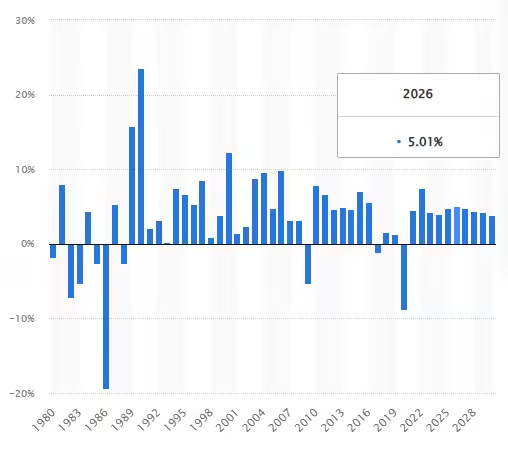
Economically, Dubai’s GDP is projected to grow by 5.01% in 2026, aiming to outperform various global sectors, including real estate, tourism, and services. Population growth and the burgeoning private industry underpin this momentum, making the city an increasingly alluring destination for businesses of all sizes.
Companies with global recognition, such as Microsoft, Amazon, and MasterCard, have successfully established a presence in the region, positioning Dubai as an ideal base for entrepreneurs seeking to grow in the Middle East.
Dubai stands as one of the globe’s most alluring business hubs, attributed to its:
- 0% personal income tax
- Strategic global location
- Rapid company setup timelines
- Full foreign ownership in many structures
The UAE is currently developing new regulations that will help Corporations, Banks, Licensing, and Digital Technologies in 2026 create a more Business-Friendly Environment for small-to-medium-sized Enterprises (SMEs), Startups, and Corporate companies to conduct business more easily and quickly, and to launch a new company.
2. Understanding Dubai’s Business Landscape
Before setting up your business, it is vital to understand Dubai’s jurisdiction. Based on your operations, ownership needs, and target audience, decide whether you want to operate on the mainland, in a free zone, or offshore.
2.1 . Mainland:
In Dubai, the term ‘mainland’ refers to areas beyond the free zones. Companies that operate in Dubai can engage in business both within the country and internationally (including other GCC countries) as long as they are appropriately registered with and licensed by the Department of Economy & Tourism (DET) of the Government of Dubai.
Since 2020, foreign investors have been able to attain 100% ownership in a wide range of sectors.
2.1.1. Mainland Licence:
Based on your business structure, sector, and operational factors, there are numerous business licenses available to you. They include the following types of business licenses:
- Commercial licence
- Industrial licence
- Dual licence
- E-trader licence
- Professional licence
Benefits:
- 100% Foreign Ownership: Most business activities now permit complete foreign ownership, affording you enhanced control and flexibility when operating on the UAE mainland.
- Corporate Tax Advantage: Companies can compete effectively in their industry by leveraging a favourable corporate tax structure, with many small businesses not paying corporate taxes and having no individual tax obligations.
- Access to a Skilled Workforce: Allows businesses to tap into a rich reservoir of experience and knowledge from around the world.
- Strategic Location For Global Marketers: Corporations operating in this region can leverage East-West trade synergies and efficiently reach their target audiences across Europe and Asia through the economic and technological advances generated by these regions.
Disadvantages:
- Regulatory Authority: Increased levels of government regulation and the requirements for companies to obtain regulatory approvals from multiple Governmental Bodies
- Emiratisation:
- 50+ Employees: Companies must ensure that a minimum percentage of their workforce (2%) is Emiratis working in a skilled role.
- 25-49 Employees: Companies need to employ at least one Emirati employee.
It is considered best for trading, retail, and service companies targeting UAE residents.
2.2 . Free Zone:
Industry-specific specialization occurs within free zones, which support specific industries through tax advantages and 100% foreign ownership of business interests.
Companies incorporated in a free zone are not permitted to operate in the UAE commercial marketplace; they must obtain a separate mainland permit to do so.
There are over 20 free zones in Dubai that cater to various sectors of business, e.g., technology, trading, finance, media, agriculture, etc.
Benefits:
- 100% Foreign Ownership: Free zones allow 100% foreign ownership of the company without the requirement of local partnerships.
- 0% Corporate Tax: The majority of free zones offer companies an initial period of at least 5 years with no corporate tax and no personal income tax.
- 0% Import Duties: Merchandise entering free zones incurs no customs duty unless it is imported to the mainland.
- Quick Registration: Each free zone is operated by a separate governing authority. They are set up to provide streamlined licensing, work permit processing, and the establishment of physical offices.
Disadvantages:
- Trade Restriction: You are prohibited from trading directly in the UAE unless you have an authorized representative there.
- Location Restriction: Sales activities must be conducted within the designated free zone designated by the UAE government.
2.3 Offshore:
Both offshore companies and companies registered in a free zone have many of the same benefits; however, they are not interchangeable.
There are several distinctions between free zone companies and offshore companies; these revolve around how each can operate. An offshore company can have operations outside the UAE, but it cannot conduct operations within the UAE.
Offshore companies do not have to deposit a minimum capital requirement prior to incorporation.
Benefits:
- Privacy: 100% confidentiality with asset protection.
- No Minimum Capital Requirement: Flexibility to structure finances in any manner desired.
Disadvantages:
- Limited Operations: Cannot conduct business operations within the local market.
- Requires Local Sponsor: Limited to 49% foreign ownership for selected operations in the UAE, local sponsors required.
Limited Banking Options: may encounter difficulty setting up a local corporate bank account.
3. Choose Your Legal Structure
One of the most critical decisions an entrepreneur faces is selecting the proper corporate structure. The way your business is structured directly affects your ownership, liability, tax obligations, growth potential, and compliance with Dubai’s laws and regulations.
These legal structures are prevalent for entrepreneurs doing business in 2026:
| STRUCTURE | OWNERSHIP | MAIN USE |
| LLC (Limited Liability Company) | 100% (most activities) | Trading and Services |
| Sole Establishment | Individual | Freelancers/consultants |
| FZE / FZCO(Free zone) | 100% | Free zone companies |
| Branch Office | Parent company | Expand a foreign company |
3.1. License Types Explained
- Industrial License: Manufacturing operations
- Freelancer Licenses: Compact option for solo entrepreneurs
- Commercial License: For trading goods
- E-Commerce License: For online businesses
- Professional License: Services and consulting
4. Step-by-Step Guide to Starting a Business in Dubai
Step 1: Define Your Business Activity
Your activities determine:
- Type of License (Commercial / Professional / Industrial / E-Commerce)
- Associated Costs
- Required Approvals
Step 2: Select Jurisdiction
Consideration of either mainland, free zone, or offshore, depending on the desired market access and budget.
Step 3: Choose and Reserve a Trade Name
Trade names must comply with UAE naming conventions and be distinct.
Step 4: Request Initial Approval
Government agency verifies business activity and jurisdiction.
Step 5: Preparing Your Legal Documents
- MoA (memorandum of association)
- LSA – Local service agreement (if applicable)
- Passport copy & proof of residency
Step 6: Securing Your Office Or Flexible Desk
Office size impacts your visa quota. Many free zones offer ‘flexible desk’ options in order to keep costs low.
Step 7: Receiving Your Trade License
After the government has received all fees and approvals, your trade license will be issued.
Step 8: Opening a Corporate Bank Account
Dubai has recently created a unified license system that allows you to open a corporate bank account in approximately 5 days.
Step 9: Visa Application Process
You must sponsor both yourself and your employees when applying for visas. Generally, visa costs range between AED3,000 and AED7,000 each.
Step 10: Regulations and Tax Registration
Depending on your turnover, you could be required to register for VAT (if your taxable turnover exceeds AED 375,000) and/or file a corporate tax return. The corporate tax rate is 9% on profits above the limit.
5. Cost of Setting Up a Business in Dubai (2026)
In 2026, start-up costs in Dubai are determined by several factors, including where you plan to establish your company, what you intend to do, and what you need for your office.
On average, if you are starting a Free Zone Company, you should budget between AED 20,000 and AED 60,000+.
For mainland businesses, start-up costs may range from AED 40,000 to AED 100,000+, depending on your office and the number of Visas required after the first year.
Free Zone (Most Startup Friendly)
| UNIT | COST |
| Trade License | AED ~10,000–20,000 |
| Co-working / Flexi Desk | AED ~5,000–30,000 |
| Visa per Person | ~AED 5,000 |
| Admin/Service Fees | AED ~3,000–8,000 |
The estimated total for the first year is ~AED 23,000–63,000+
Mainland:
| UNIT | COST |
| Trade License | AED ~15,000–30,000 |
| Office Rent | AED ~15,000–50,000 |
| Visa | ~AED 5,000 |
| PRO Services | AED 5,000–10,000 |
Estimated first-year range: AED 43,000–95,000+
Offshore:
Estimated total: AED 10,000–20,000
Best for: asset holding and global trade entities.
6. Opening a Business Vs. Getting a Freelancer License In Dubai
Starting a business is ideal for many, but in some cases, you may want to explore the possibility of a Freelancer Visa instead. You will still have the ability to invoice your clients, receive payments, and take advantage of other benefits that come with being a freelancer, but you won’t be able to sponsor other employees. At the same time, the Freelancer Visa is a much easier way to set up your business, with fewer paperwork requirements and lower costs.
7. Specialized Benefits for GCC Nationals
The Emirate of Dubai offers a variety of unique incentives to promote regional entrepreneurship and business growth among Gulf Cooperation Council (GCC) nationals.
According to the official Invest in Dubai website, potential investors from the UAE (United Arab Emirates) or other GCC countries who are interested in starting a home-based business in the Dubai area can do so at an annual cost that is only a fraction of what it would typically cost to launch.
This benefit is Part of Dubai’s effort to build an ecosystem of support for the region’s talent and to create an environment of economic integration among the Gulf Cooperation Council (GCC) by removing barriers and providing customized solutions for Gulf citizens who want to start or grow their businesses in the Emirates.
6. Key Business Countdown
Small Business Relief (SBR) will end on December 31, 2026. Starting a business in Dubai now (January 2026) presents a clear tax landscape for the coming year.
6.1. A “Safety Net” exists with Small Business Relief (SBR)
- The 9% tax on income over 375,000 AED in 2026 will not generally apply to many startup businesses, as it is optional for them.
- How It Works: If your gross revenue is 3,000,000 AED or less, you may apply for Small Business Relief.
- How It Helps: You will be able to claim that you earn no taxable income and, your taxes will be zero, regardless of your profits.
- Important: Small Business Relief is scheduled to end on December 31, 2026, and unless the government extends it later this year, your business will begin to pay the standard 9% profit-based tax, as shown in the graphs above, on January 1, 2027.
6.2. The Standard 9% Regime
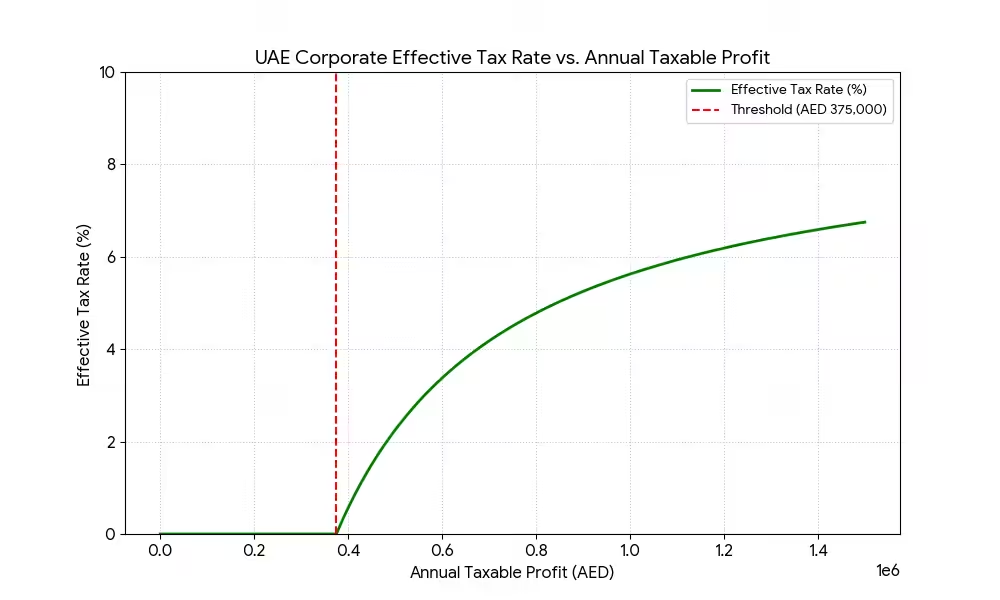
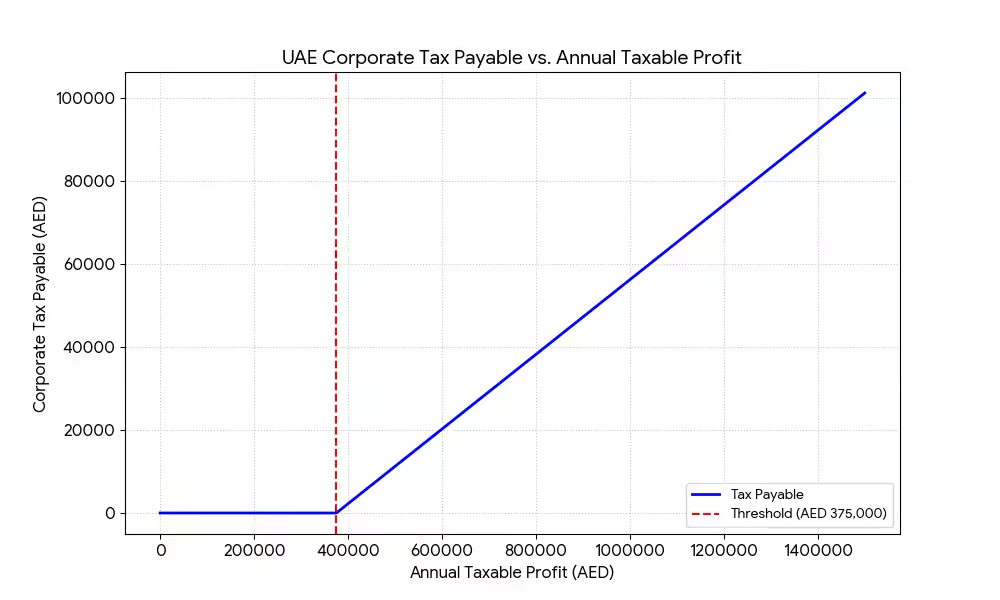
The chart corresponds directly to the Permanent Law that persists post Relief expiration.
2026 Criteria:
- Your revenue exceeds 3,000,000 AED annually.
- You opt not to utilize the Small Business Relief (some companies have used this as an opportunity to “carry forward” losses into future tax years).
- You are either a Mainland business or a Free Zone business that does not qualify for “Qualifying” status.
6.3. Critical 2026 Compliance Updates
The initiation of business operations in 2026 entails more stringent procedural requirements than in previous years.
- Corporate Tax Registration is compulsory and can only be completed after you register with the EmaraTax Portal, even if you believe that your company will not generate any revenue and/or qualify for tax relief. Additionally, there is now a fixed fine of 10,000 AED for late registration.
- Due to the upcoming implementation of an Electronic Invoicing System for most B2B transactions occurring in the UAE on/after July 2026, you must ensure that the accounting software you use is compliant with this new system.
- If you establish your business in a Free Zone and wish to avail of the 0% “Qualifying” tax rate, you must submit your company’s audited financial statements (these requirements apply to tax periods beginning with 2025/2026).
7. Quick Startup Checklist:
- Decide on business activity
- Pick jurisdiction
- Register trade name
- Get initial approval
- Finalize legal docs
- Secure office/flexi desk
- Receive license
- Open a bank account
- Apply for visas
- VAT & corporate tax registrations
8. Conclusion:
If you’re aiming to start your own business in Dubai, you will need to consider several factors to build a solid foundation for your business Model and ensure compliance with all necessary physical and legal requirements. Once you know the business type, you will need to develop a plan for costs, compliance, and reaching your target market.
The process for starting a business in Dubai in the future will be streamlined, due to its well-established and modern business environment, and your company’s ability to take advantage of this will be dependent on selecting the correct business model.